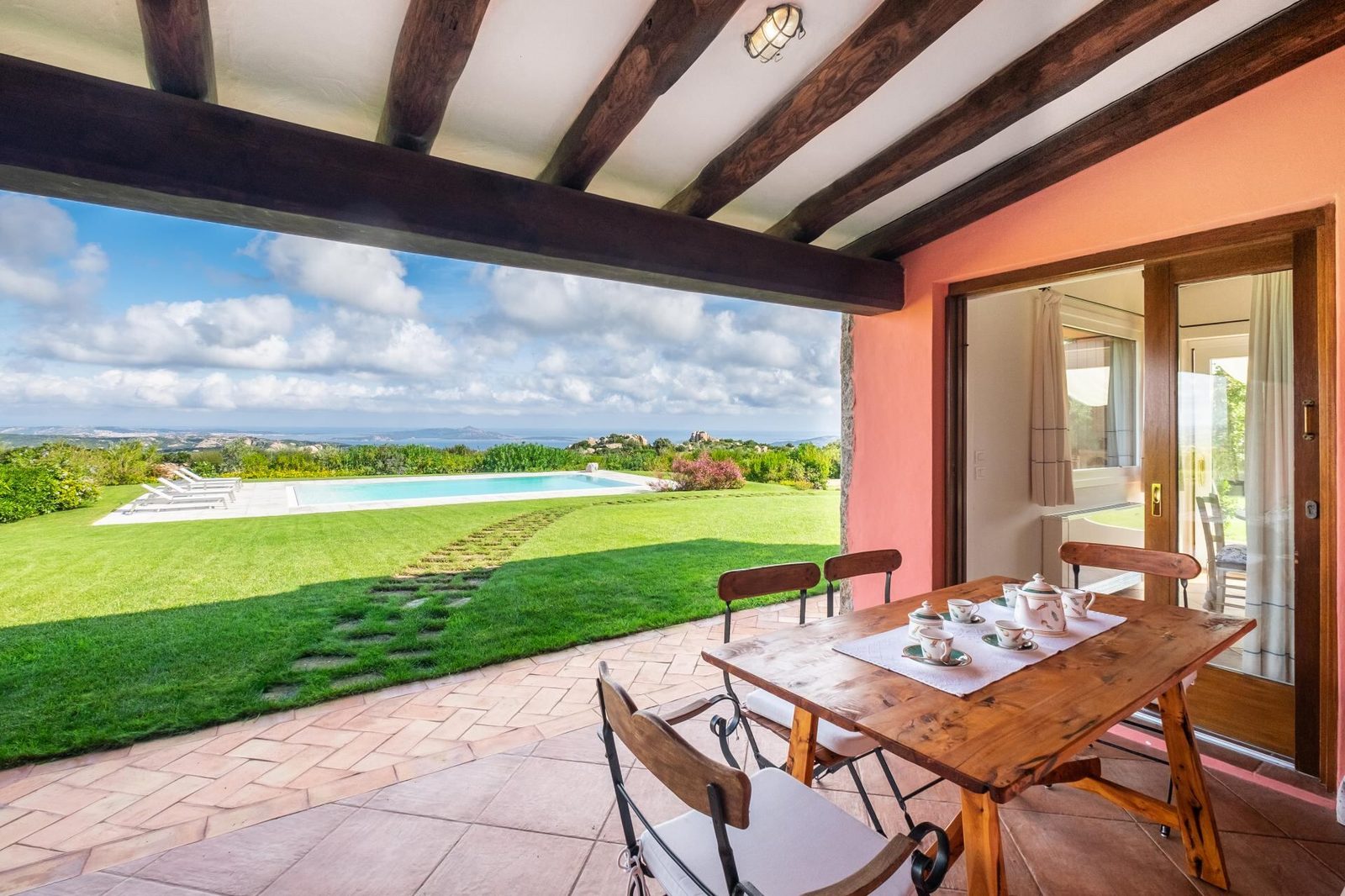
A three-bedroom home in Cannigione, Costa Smeralda, Italy.
Costa Smeralda Rental Yield: The Real Numbers for Americans

September 2026
Quick Answer
A mid-size Costa Smeralda villa can gross 100,000 to 130,000 EUR across an 18 to 20 week season. After platform and management fees, Italian rental income tax, and maintenance reserves, net yield typically lands near zero or negative as a percentage of asset value. Costa Smeralda is a luxury asset with a partial summer income offset, not a yield investment.
American buyers researching Costa Smeralda usually arrive at the same starting assumption: villas that rent for tens of thousands of euros a week must be extraordinary investments. The weekly rate is real. What it produces once the season length, the fee structure, and Italian tax are applied against a multi-million-euro purchase price is a different number entirely, and it is rarely what the listing photos imply.
This is the same gap that shows up on the Amalfi Coast, but Costa Smeralda's version of it is sharper. The season is shorter, the entry prices are higher, and the market is built around a buyer who is not optimizing for yield in the first place. Understanding that before you buy changes what you should actually be evaluating.
What a Costa Smeralda Villa Actually Rents For
| Villa Size | Peak Season (Jun–Aug) | Shoulder (May, Sept) | Typical Locations |
|---|---|---|---|
| 2 to 3 bedrooms | €4,000 to €10,000/week | €1,500 to €4,000/week | Cannigione, Porto Cervo periphery |
| 5 to 6 bedrooms | €9,000 to €21,000/week | €4,000 to €9,000/week | Porto Cervo, Porto Rotondo |
| 7+ bedrooms, ultra-luxury | €25,000 to €70,000+/week | €10,000 to €25,000/week | Porto Cervo, Punta Lada, Capo Coda Cavallo |
Illustrative ranges based on published villa rental listings across the Costa Smeralda market. Actual rates vary by proximity to the marina, sea view, staff inclusion, and specific season week.
The Rental Season
Costa Smeralda's bookable season runs roughly 18 to 20 weeks: an 8-week peak from mid-June through August, and a shoulder period across May and September where demand and rates drop by half or more. From November through April, the coast is functionally closed. Restaurants shutter, staff disperse, and rental demand approaches zero. This is not a market where a shoulder-season strategy or off-season pricing adjustment meaningfully extends the income window. The calendar is what it is, and the closed months are longer than the open ones.
The Cost Structure
The table below models a 5-bedroom Porto Cervo villa purchased for approximately 3 million EUR, run through a full peak-and-shoulder season with professional villa management, a category most serious Costa Smeralda rental properties require given staffing, turnover, and guest-services expectations at this price point.
| Item | Illustrative Annual Amount |
|---|---|
| Gross rental income (8 peak weeks + 8 shoulder weeks) | €125,000 |
| Villa agency and platform fees (18%) | –€22,500 |
| Property and staff management (25%) | –€31,250 |
| Italian rental income tax (cedolare secca, 21%) | –€26,250 |
| Maintenance reserve (1.5% of €3M) | –€45,000 |
| Insurance, utilities, IMU property tax | –€10,000 |
| Net result before US tax | –€10,000 (–0.3% of asset value) |
The math lands at approximately breakeven to slightly negative before any US-side tax treatment. This is not a modeling error. It is the structural reality of a short, high-cost season applied against a high asset price. A villa that grosses six figures in rental income can still fail to cover its own carrying costs once management, tax, and maintenance are counted honestly rather than cherry-picked from a single strong peak week.
Italian Rental Income Tax and Registration Rules
Rental income from Italian property is taxable in Italy regardless of the owner's nationality or where they live. Non-resident Americans may elect the cedolare secca (substitute flat tax) for qualifying short-term rentals rather than being taxed at ordinary progressive rates, and that income must still be reported to the IRS on Schedule E, with a foreign tax credit available for Italian tax already paid. Since 2024, Italy also requires a CIN (Codice Identificativo Nazionale, national identification code) displayed on every short-term rental listing, part of a national push to formalize and track short-term rental activity. Full mechanics of both are covered in the Italian rental income tax guide and the national short-term rental rules guide.
The PPR Coastal Restriction
Nearly all Costa Smeralda inventory sits within Sardinia's Piano Paesaggistico Regionale (PPR) coastal buffer, which restricts construction and significant renovation within 300 meters of the shoreline. For a rental property owner, this matters beyond aesthetics: adding a pool, an annex for staff or additional guests, or any exterior expansion that would increase rental capacity may not be legally possible regardless of what the current structure suggests. Confirm PPR status with an independent Italian attorney before assuming a property's rental potential can grow. Full detail is in the Sardinia due diligence guide.
Costa Smeralda vs. the Amalfi Coast
| Factor | Costa Smeralda | Amalfi Coast |
|---|---|---|
| Peak weekly rate (5BR villa) | €9,000 to €21,000 | €8,000 to €15,000 |
| Bookable season length | ~18–20 weeks | ~16–18 weeks |
| Entry price (comparable villa) | €2M to €3M+ | €1M to €2M+ |
| Net yield character | Near zero to negative | Near zero, slightly positive |
| Renovation constraint | PPR (300m coastal buffer) | UNESCO Soprintendenza oversight |
| Buyer profile | European ultra-HNW, summer anchor | US and international, higher personal-use weighting |
Costa Smeralda's higher absolute rates do not translate into a better yield. They are offset by a proportionally higher purchase price and a season that, while slightly longer on paper, is concentrated into fewer truly high-demand weeks. The two markets arrive at a similar conclusion by different routes.
Who Costa Smeralda Actually Suits
Buyers who already own in other prestigious European or global markets, who want a European coastal address with peer adjacency during a specific six-to-eight-week window, and who are financially indifferent to whether the property covers its own carrying costs. It does not suit a buyer modeling the purchase as a yield-generating investment, or one who needs the property to be self-sustaining. Treat any rental income as a partial offset against ownership cost, not as the reason to buy.
Evaluating a Costa Smeralda Purchase?
Peter can walk through the realistic yield math for a specific property, the PPR status, and how it compares against inland Sardinia or the Amalfi Coast for your situation.
Submit an Inquiry Full Sardinia Region GuideFrequently Asked Questions
What is the rental yield on a Costa Smeralda villa?
Typically well under 2% of asset value annually, and often near zero or negative once platform fees, management, Italian rental income tax, and maintenance reserves are counted against a roughly ten-week peak season. A mid-size villa priced around 3 million EUR can gross 100,000 to 130,000 EUR in a strong season, but costs frequently consume most or all of that before any distribution to the owner.
How long is the Costa Smeralda rental season?
Roughly 18 to 20 weeks of bookable demand, split between an 8-week peak from mid-June through August and a shoulder period in May and September. November through April sees minimal tourist activity and negligible rental income.
What weekly rate can a Costa Smeralda villa command?
A 3-bedroom villa in Porto Cervo or Cannigione typically rents for 4,000 to 10,000 EUR per week in peak season. Larger 6-bedroom-plus luxury villas command 20,000 to 70,000 EUR per week or more, depending on location, staff, and proximity to the marina.
Do Americans pay Italian tax on Costa Smeralda rental income?
Yes. Italian-source rental income is taxable in Italy regardless of the owner's nationality or residence. Non-resident Americans may elect the cedolare secca substitute tax regime for qualifying short-term rentals. The income must also be reported to the IRS on Schedule E, with a foreign tax credit available for Italian tax paid. See the Italian rental income tax guide for full mechanics.
Is Costa Smeralda a better rental investment than the Amalfi Coast?
Neither is a yield investment in the conventional sense. Costa Smeralda commands higher absolute weekly rates on comparable villa sizes, but its season is shorter relative to its entry prices, producing a similar or slightly worse net yield percentage than Amalfi Coast property. See the Amalfi Coast rental yield guide for the direct comparison.
What is the PPR and does it affect Costa Smeralda rental properties?
The Piano Paesaggistico Regionale restricts construction and significant renovation within 300 meters of Sardinia's coastline, which covers nearly all Costa Smeralda inventory. It affects what a rental property owner can add or change, such as a pool expansion or guest annex, and must be verified before purchase.